Remember
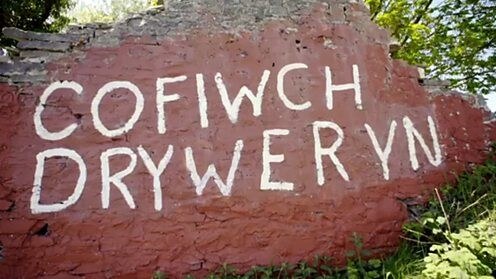
If you are travelling on the A487, overlooking Llanrhystud, en route to or from Aberystwyth, you will see the sign ‘Cofiwch Dryweryn’ in a layby. Whilst this may look like a graffiti drawing, it is actually hugely significant for this part of Wales and the country as a whole.
Translated as ‘Remember Tryweryn’, this sign is a permanent and poignant reminder of the Welsh village Capel Celyn (Holly Chapel) in the Tryweryn valley that was flooded to provide water for the City of Liverpool and Wirral. As the Lil Celyn reservoir was formed, along with the village itself, an entire valley was drowned and residents and nearby farms were uprooted with 100s of acres of agricultural land lost forever.
The Liverpool Corporation Act started as a private bill but was subsequently passed by the Conservative Government and the Liverpool Corporation. The Act allowed for the acquisition of land and rights in Tryweryn Valley near Bala, Merion. However, the Act passed without consultation with any Welsh authorities and was not supported by any Welsh MPs at Westminster.
Nevertheless, work on the reservoir starting three years later in 1960. Yet, opposition to it had begun years earlier with the residents of Capel Celyn gaining support from local and national institutions as well as notable individuals forming the Tryweryn Defence Committee (Pwyllgor Amddiffyn Tryweryn). The National Party of Wales (Plaid Genedlaethol Cymru), later Plaid Cymru, were also vocal in their opposition. The project was seen as an infringement to Wales as a whole.
The memorial, on the wall of a ruined stone cottage, was painted before the flooding of the valley, perhaps as early as 1960. Originally, this said Cofiwch Tryweryn which was without the soft mutation and, therefore, strictly incorrect. However, it has been repainted many times (the latest in August 2018). Tryweryn became Dryweryn many years ago.
On 19 October 2005, around the 50th anniversary of the flooding of the Tryweryn valley, Liverpool City Council issued a formal apology for the flooding. This quoted the ‘insensitivity’ of previous administrations and, even though it was welcomed by some, it was too-little -too-late for many and the Cofiwch Dryweryn monument remains a powerful phrase in the Welsh language. It is seen as a rallying call for Welsh nationalism, urging Welsh speakers to remember the destruction of a Welsh-speaking community and the importance of maintaining and safeguarding the language.
The monument featured in the music video for the Manic Street Preachers single, Distant Colours from the album Resistance Is Futile
Location Information